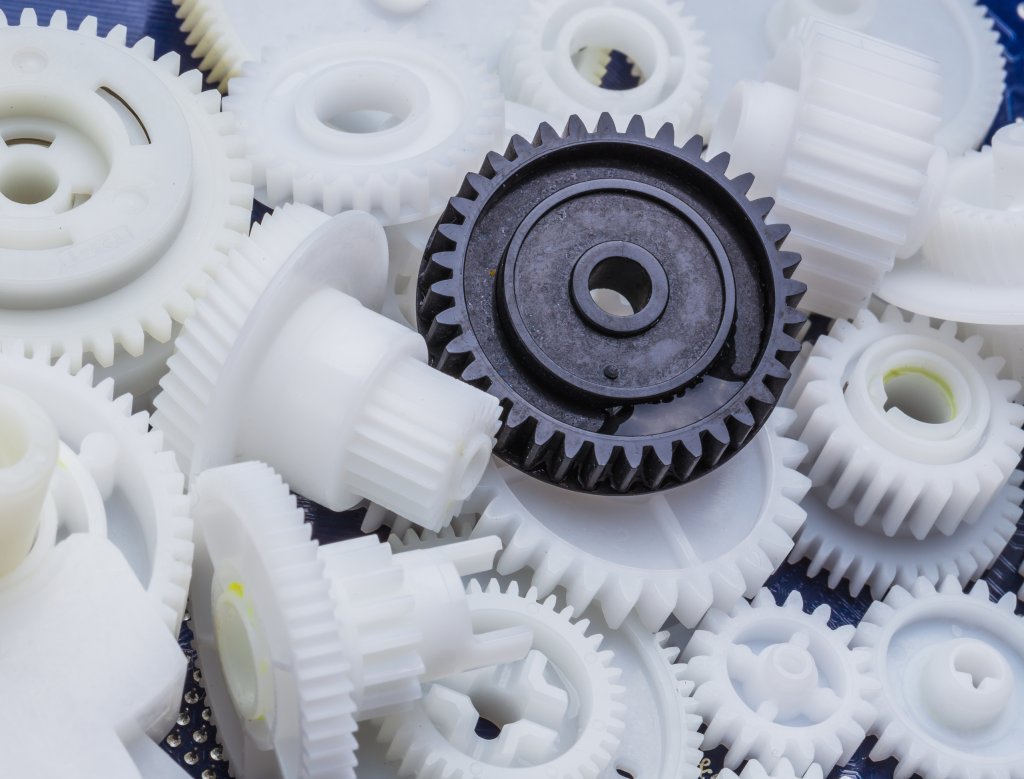
What is Delrin®?
Delrin® is a DuPont resin brand name for polyoxymethylene (POM), more specifically referred to as an acetal homopolymer. It’s a semi-crystalline engineering-grade thermoplastic that offers superior dimensional stability, high strength, wide operating temperature range, and low friction. Delrin’s many valuable properties make it a perfect material for creating highly durable and precision-based components.


An Expert is just around the corner.
With over 100 years of combined product knowledge and industry experience, we are confident our plastics experts can help you find a solution for your application.
Acetal Copolymer vs. Delrin Acetal Homopolymer
Acetal plastics are available in two primary formulations: acetal copolymer and acetal homopolymer, most commonly known by the trade name Delrin. While both offer good strength, stiffness, and machinability, Delrin is the higher-performance option for most mechanical applications.
Compared to acetal copolymer, Delrin provides greater tensile strength, stiffness, and fatigue resistance, along with a lower coefficient of friction and better wear performance — making it the preferred choice for precision parts, gears, bearings, and other load-bearing or dynamic applications. Acetal copolymer does hold an advantage in chemical resistance and is less prone to centerline porosity in thicker sections, which can make it a better fit for fluid handling or chemically aggressive environments.
For applications requiring the best combination of mechanical performance, tight tolerances, and consistent wear behavior, Delrin is typically the stronger specification.
Characteristics and Benefits of Delrin
Delrin serves as an excellent alternative for metal due to its high wear resistance, high-tensile strength, low friction, and superior resistance to warping. It also offers overall durability and toughness, perfect for demanding use.
In addition to its benefits as a replacement for metal, Delrin’s material properties include superior density, low moisture absorption, and chemical resistance to hydrocarbons, solvents, and neutral chemicals. Here is a breakdown of Delrin's various properties.
Properties of Delrin Plastic
Mechanical
Since Delrin is produced as an extruded acetal material, it is typically offered in a single, standardized molecular weight. It maintains excellent strength and stiffness at room temperature, delivers a tensile strength of approximately 10,000 psi, and features a high flexural modulus of about 420,000 psi. These characteristics provide outstanding rigidity in load-bearing applications.
In addition, Delrin performs exceptionally well in sliding and wear applications. The coefficient of friction is very low (typically between 0.1 and 0.3) and remains relatively stable across a wide range of temperatures, loads, and surface speeds, making it a reliable choice for precision components and moving parts.
Chemical
Delrin offers strong resistance to organic solvents, hydrocarbons, and natural chemicals, making it well suited for many industrial environments. It is also resistant to fuels, oils, and mild alkalis. That said, Delrin is not ideal for environments involving strong acids, strong bases, or oxidizing agents.
Because Delrin is not subject to attack by fungi, insects, or other pests, it is an excellent choice for many underground applications. It also features superior staining and discoloration resistance at temperatures below 160°F.
Thermal
Because Delrin does not rely on plasticizing to achieve its toughness, it does not suffer from brittleness at low temperatures. Its impact resistance at temperatures as low as -40°F is only 20% less than its resistance at room temperature.
At elevated temperatures, Delrin retains good strength retention, with a tensile strength of approximately 2,000 psi and a flexural modulus of 180,000 psi measured at 200°F. Continuous-use service temperatures are 180°F in open air and 150°F in water, with the ability to withstand brief temperature peaks of up to 250°F.
Electrical
Delrin is an excellent dielectric material, exhibiting notably low dissipation factors and dielectric constants across a broad range of temperatures and frequencies. In addition, it maintains favorable dielectric properties in high-humidity environments and when completely submerged in water.
Uses For Delrin Plastic
Delrin's combination of mechanical strength, dimensional stability, low friction, and moisture resistance makes it a go-to material across a wide range of demanding industrial applications. Common uses include gears, bearings, bushings, rollers, fittings, and electrical insulator parts. Essentially anywhere tight tolerances, consistent wear performance, and long service life are required.
Parts exposed to moist or wet environments, such as pump and valve components, are especially well suited to Delrin, as its low moisture absorption ensures dimensional stability and sustained mechanical performance over time. Water management controls, flow regulators, and fluid handling fittings are other natural fits.
In automotive and industrial settings, Delrin is widely specified for sliding and guiding parts, conveyor system components, scraper blades, door systems, and safety restraint components. Leading manufacturers specify Delrin for high-load mechanical applications such as gears, safety restraints, door systems, and conveyor belts.
Unfilled Delrin in natural and black grades is FDA, USDA, NSF, and 3A-Dairy compliant, making it well suited for food processing equipment, packaging machinery, and beverage handling components.
In medical and healthcare applications, Delrin's biocompatibility supports its use in drug delivery devices, inhalers, pen injectors, syringes, diagnostic equipment, and gas and fluid handling systems. It is also used for surgical instruments and prosthetic components. Note that for permanent load-bearing implants, material selection should be verified against applicable regulatory and clinical requirements, as higher-performance materials such as PEEK are more commonly specified for those applications.
Get a Quote for Delrin Sheet, Rod, and Tube at Piedmont Plastics
Piedmont Plastics stocks extruded Delrin and acetal sheet, rod, and tube, with compression-molded sheet available upon request. Need a custom size? We offer cut-to-size materials and value-added services to help ensure your material meets the exact requirements of your application.
Delrin Rod:
Diameters: 0.187" to 9"
Standard lengths: 1', 5', and 10'
Delrin Sheet:
Thicknesses: 1/16" to 4"
Standard widths: 12", 24", and 48"
Standard lengths: 24", 48", and 120"
Buy Delrin From Piedmont Plastics Today!
We can customize your order to accommodate the sizes and lengths that fit your manufacturing needs. Contact us, and we’ll put you in touch with our plastics experts, who can help you locate high-quality project materials like Delrin from our North American network of Piedmont Plastics branches.
Contact Us